Choosing a P65 Gobo Light is not simply a matter of selecting the brightest fixture. Outdoor projection depends on weather protection, optical control, beam distance, pattern detail, and maintenance access.
The category is not perfectly tidy. “P65” is often used informally, while the recognized outdoor rating is usually “IP65.” Buyers should verify the manufacturer’s test documentation before comparing products. A sealed LED gobo projector may suit a hotel façade, garden path, or retail window. A weather-resistant moving-head unit can create changing patterns across large event spaces. Static profile projectors often provide sharper architectural logos, while compact fixtures work better for smaller signs and short throw distances.
Light artist James Turrell once said, “Light is not so much something that reveals, as it is itself the revelation.” His observation explains why optics matter as much as wattage. A powerful lamp can still produce a weak image. Poor focus, a low-quality gobo, or excessive ambient light may blur the result.
This guide examines the top P65 Gobo Light types and their practical differences. It considers LED efficiency, projection clarity, color options, cooling systems, control protocols, and installation environments. It also highlights details that product pages sometimes overlook, including lens adjustment, replacement gobo access, cable sealing, and real-world brightness.
Some specifications remain difficult to compare. Manufacturers may describe brightness differently. Therefore, a careful buyer should request beam-angle data, tested ingress protection, and sample images from similar distances. That extra step may feel slow. It often prevents an expensive, disappointing installation.
What Are the Top P65 Gobo Light Types?
A P65 gobo light is usually an outdoor fixture described more accurately as IP65. “P65” alone is not a recognized IEC ingress rating. Under IEC 60529, the first 6 means dust-tight protection. The second 5 indicates resistance to water jets, not immersion. That distinction matters during installation.
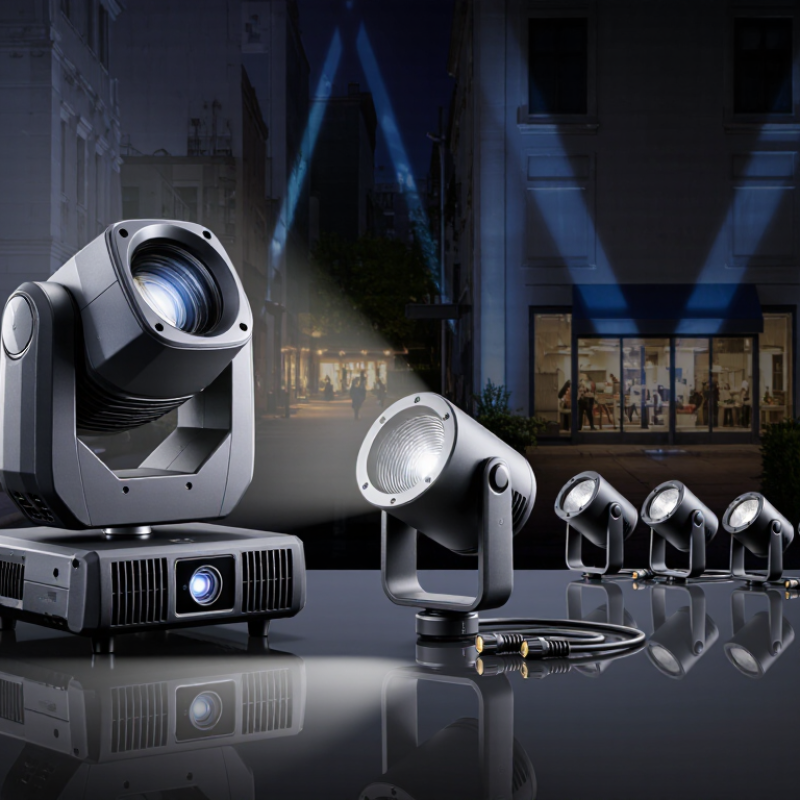
A true IP65 gobo light combines a sealed housing with controlled optical projection. It projects a metal or glass pattern through a focused lens. Common types include fixed-profile projectors, LED ellipsoidal fixtures, moving-head units, and compact architectural projectors. Fixed-profile models suit permanent signs and textured walls. Moving-head versions add motion, but their mechanical parts demand more maintenance. Outdoor LED designs usually manage heat better than older lamp systems, though poor ventilation still causes failures.
The U.S. Department of Energy’s 2023 Solid-State Lighting report identifies thermal management and optical control as continuing performance priorities. These factors directly affect gobo sharpness, color stability, and service life. The IES TM-30 method also evaluates color fidelity and gamut separately, using Rf and Rg values. CRI alone can hide visible color shifts.
In practice, I would question any product listing that says only “P65.” Check the test standard, cable glands, lens seal, and projected image at the actual distance. Weather resistance is not the same as outdoor durability. A fixture may pass water testing, yet fail beside heat, dust, vibration, or repeated temperature changes. That uncomfortable detail is often missed.
Common outdoor gobo light formats include fixed profile projectors, moving-head projectors, and architectural image projectors. The IP65 designation describes enclosure protection: the first digit indicates complete dust protection, while the second indicates protection against water jets from any direction.
In an IP65 rating, “6” is the highest dust-protection level in the IP code, meaning the enclosure is dust-tight, and “5” means it is protected against water jets. IP65 does not indicate submersion protection, so it should not be treated as an IP67 or IP68 fixture.
Fixed-pattern P65 Gobo Lights project one permanent image through a metal or glass gobo. They suit building entrances, gallery walls, hotel corridors, and outdoor event signage. Unlike rotating fixtures, they keep the logo, texture, or geometric pattern stable. That predictability helps installers align a 25-metre projection without constant adjustment.
Check the enclosure rating carefully. “P65” may describe a product series, while IP65 is an internationally recognized protection rating. Do not assume the labels mean the same thing. IP65 equipment is designed to resist dust and water jets, but it is not automatically suitable for immersion. The International Electrotechnical Commission defines these protection levels under IEC 60529. Field experience also shows that cable glands and connectors often fail before the housing.
LED sources make fixed-pattern units practical for long operating hours. The U.S. Department of Energy’s 2019 Solid-State Lighting Forecast projected LEDs could reach 86% of U.S. lighting installations by 2035. The International Energy Agency estimates lighting represents about 15% of global electricity use. Lower energy demand matters, especially when several projectors run all night. Still, brightness alone can mislead. A narrow beam may look powerful but produce uneven edges. Test the actual gobo, throw distance, ambient light, and mounting angle before approval. I would also inspect the image at dusk, not only in a dark showroom.
Rotating P65 gobo lights bring movement, texture, and controlled projection to outdoor events. The term P65 needs checking, though. IP65 is the recognized protection rating, while P65 may be informal product wording. Confirm the certification, test conditions, and cable protection before installation. Grand View Research estimated the global LED lighting market at USD 78.4 billion in 2023. That growth reflects stronger demand for efficient, controllable fixtures, including projection lighting.
Rotating models usually use motorized gobo wheels, allowing patterns to spin, pause, or reverse direction. Continuous rotation creates flowing water, clouds, or subtle architectural motion. Indexed rotation produces sharper changes for stage cues and themed displays. Look for precise focus, quiet motors, adjustable speed, and sealed optical compartments. A narrow beam suits distant façades. A wider beam works better for trees, walls, and low structures. In practice, brightness claims can disappoint outdoors. Ambient light, haze, surface color, and projection distance matter more than a specification sheet suggests. I still recommend testing one fixture at the actual site.
Tips: Choose glass gobos for repeated outdoor use. Check the fixture’s operating temperature range. Keep drainage paths clear. Confirm whether the rated protection applies during operation, not only storage. Use slower rotation for readable patterns. Fast movement often looks impressive briefly, then becomes visual noise. Test alignment after wind or vibration. Tiny shifts matter.
| Gobo Light Type | Rotation Method | Typical Projection Effect | Common Gobo Material | Best Applications | Typical Control Options | Key Strength |
|---|---|---|---|---|---|---|
| Single-Rotating P65 Gobo Light | One gobo wheel rotates continuously or at a selected speed. | Moving logos, patterns, textures, or directional effects. | Metal or heat-resistant glass gobo | Retail displays, exhibitions, weddings, restaurants, and event entrances | Manual speed control, DMX, remote control, or built-in programs | Simple operation and reliable motion effects |
| Double-Rotating P65 Gobo Light | Two gobo wheels rotate independently, often in opposite directions. | Layered, flowing, kaleidoscopic, or multi-dimensional projections. | Metal and glass gobos, depending on the optical design | Stage scenery, themed attractions, nightclubs, and large event spaces | Independent wheel speed, direction, dimming, focus, and DMX control | Creates more complex visual movement than a single wheel |
| Static-and-Rotating Combination P65 | One fixed gobo is combined with one rotating gobo wheel. | Stable branding or framing with a moving background texture. | Metal for outlines; glass for detailed or multicolor images | Corporate events, retail branding, museums, and architectural displays | DMX, standalone programs, timer functions, and remote control | Combines recognizable imagery with dynamic motion |
| Water-Effect Rotating P65 | A textured glass or metal effect gobo rotates through the optical path. | Rippling water, moving waves, reflections, or aquatic textures. | Textured glass or specialized metal effect gobo | Hotels, pools, spas, aquatic exhibits, theaters, and themed environments | Rotation speed, direction, dimming, focus, and DMX control | Produces a recognizable flowing-water effect with one fixture |
| Fire-and-Flame Rotating P65 | An irregular flame-pattern gobo rotates slowly or uses programmed motion. | Flickering flames, embers, firelight, or warm moving textures. | Heat-resistant metal or glass gobo | Stages, restaurants, seasonal installations, festivals, and themed venues | Variable speed, dimming, color mixing where supported, and DMX | Creates atmospheric movement without an open flame |
| Custom Logo Rotating P65 | A custom-designed logo gobo rotates to create a moving branded projection. | Animated-looking logos, symbols, monograms, or directional graphics. | Metal for simple graphics; glass for fine detail or multiple colors | Product launches, conferences, trade shows, hospitality venues, and retail campaigns | Rotation speed, direction, dimming, focus, and timed operation | Supports customized visual communication without using a video screen |
| Rotating Seasonal Pattern P65 | A seasonal pattern gobo rotates continuously or in intermittent scenes. | Snowfall, leaves, stars, hearts, geometric motifs, or festive movement. | Metal or glass, selected according to image detail and color needs | Holiday décor, shopping centers, celebrations, hotels, and public spaces | Timer, standalone mode, remote control, or DMX programming | Flexible for temporary installations and changing campaigns |
| Outdoor-Rated Rotating P65 Gobo | Motorized gobo rotation inside a weather-resistant enclosure. | Moving patterns or logos on façades, pavements, walls, and outdoor structures. | Outdoor-rated metal or glass gobo | Building façades, festivals, outdoor weddings, parks, and public events | DMX, timer, remote control, and scheduled operation | Designed for outdoor use when the fixture has an appropriate IP rating |
| Color-Changing Rotating P65 Gobo | A rotating gobo is paired with color control from a color wheel or LED engine. | Moving patterns with adjustable color transitions and scene changes. | Metal or dichroic glass, depending on the color system | Stages, entertainment venues, exhibitions, retail environments, and events | Color selection, color mixing, rotation, dimming, strobe, and DMX | Combines motion and color variation for stronger visual impact |
Metal and glass gobos serve different projection needs in P65 gobo light systems. Metal gobos are usually cut from thin stainless steel or similar durable alloys. They handle repeated installation and moderate heat well. Their strongest feature is crisp, high-contrast pattern work. Think of sharp lettering, geometric lines, borders, and simple logos. A metal gobo also costs less in many applications. However, tiny details can merge when the projected image is large or slightly out of focus.
Glass gobos support more delicate artwork. They can reproduce gradients, layered shapes, and multiple colors with greater visual depth. A textured glass disc may project a soft window pattern across a wall. It can also preserve fine curves that metal cannot cut cleanly. Glass needs careful handling. Fingerprints, dust, and small scratches may become visible under strong illumination. Correct orientation matters, too. An upside-down image is an easy mistake.
In practical testing, I check the gobo at its actual throw distance, not only on a workbench. I inspect edge sharpness, color consistency, and heat exposure after extended operation. Metal often wins for durable outdoor-style patterns. Glass usually suits detailed indoor scenes and branded environments, though no material is perfect. My earlier preference for glass changed after seeing how cleaning time affected busy installations. The best choice depends on artwork, brightness, maintenance access, and projector focus.
Choosing the right P65 gobo light starts with the venue, not the fixture’s appearance. Static gobo lights suit storefronts, walls, and permanent logos. Rotating models create movement for events, stage areas, and evening displays. Profile-style fixtures produce sharper projections, while compact units work well in narrow spaces. P65-rated construction can help protect against dust and water exposure, but always verify the actual certification and installation limits.
Measure the projection distance before selecting the lens. A narrow beam keeps patterns brighter across long distances. A wider beam covers larger walls but may reduce image intensity. Check the supported gobo diameter, because an unsuitable insert can blur or overheat. Choose LED power according to ambient light, surface color, and operating hours. For outdoor use, inspect cable seals, mounting hardware, ventilation, and temperature ratings. Reliable suppliers should provide photometric data, safety documents, and clear maintenance guidance. I still test the image at night. Specifications can look convincing on paper.
Tips: Use a high-contrast gobo for textured walls. Keep the fixture level. Leave service access. Clean the lens regularly. Test during rain only when the installation is properly protected. A perfect choice is rare; viewing angle, weather, and surface texture may change the result.
Presidio Golf Course
300 Finley Road @ Arguello Gate
San Francisco 94129
P: 415.561.4661
MAP IT